Your competitors are showing up on Google. You are not. Here is exactly why, and how to fix it.
Remember those early days of the Green Rush, where having a website could take you all the way? Well, those were the days. Today, the landscape is much, much different. Today, the world of dispensaries, CBD brands, and other cannabis companies is a high-stakes battle, governed by unforgiving algorithms and even more unforgiving policies. If you’ve tried Google Ads, only to have your account banned within hours, you know what I’m talking about.
Here’s the harsh truth: cannabis SEM is not impossible. It’s just highly, highly nuanced. While generalists struggle with compliance issues, A-player brands are leveraging AI-driven SEO techniques, combined with strategic paid search techniques to reach high-intent buyers exactly when they’re ready to make a purchase.
What Is Cannabis SEM, And Why Is It Different?
To win in 2026, you have to move beyond the idea that SEM is just “buying ads.” At Spokes Digital, we define cannabis search engine marketing as a unified three-part system:
- Organic SEO: Building long-term authority so you rank for “best dispensaries in [City].”
- Paid Search (PPC): Capturing immediate traffic through compliant Google Ads and programmatic search.
- Local SEO: Dominating the “Map Pack” to drive physical foot traffic.
Why Standard Advice Fails
Most marketing gurus suggest “bidding on high-volume keywords and sending traffic to a sales page.” In the cannabis world, that is a one-way ticket to a permanent Google ban. Standard SEM ignores the “Grey Zones”, the shifting policies where Google allows hemp-derived CBD but restricts THC, or allows “informational” content but flags “promotional” language.
The Spokes Digital Difference
We use a compliance-first approach. This means we don’t just “try” things; we use proprietary frameworks to ensure your brand remains visible without triggering the red flags that sink your competitors. This guide will pull back the curtain on how we navigate these complexities to deliver results that other agencies call impossible.
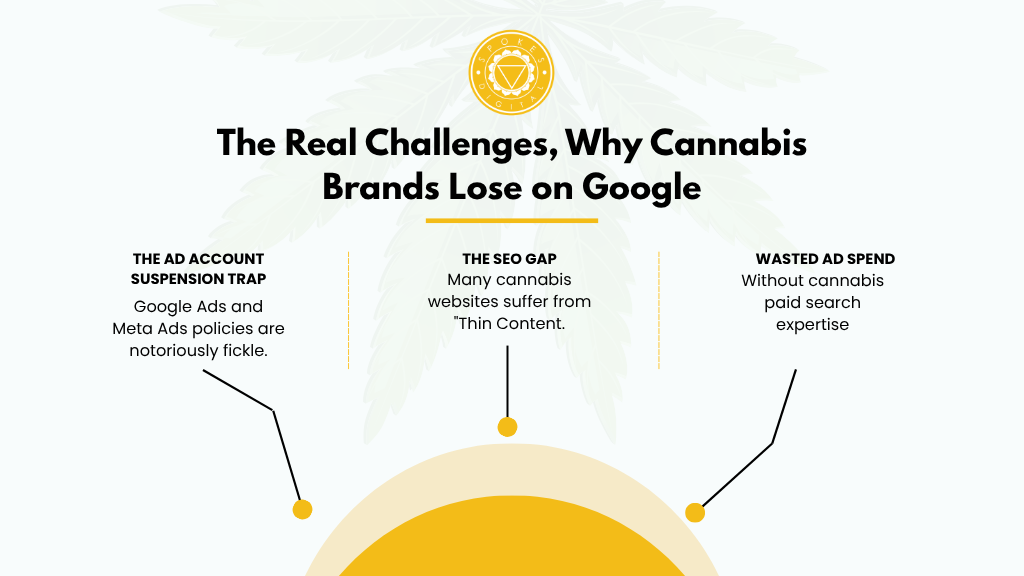
The Real Challenges, Why Cannabis Brands Lose on Google
If it were easy, everyone would be doing it. The reason most dispensary SEM campaigns fail is a lack of technical nuance.
The Ad Account Suspension Trap
Google Ads and Meta Ads policies are notoriously fickle. A single word like “pre-roll” or “delivery” on a landing page can trigger an automated crawler to suspend your entire ad account. Often, brands lose their accounts not because of the ad itself, but because their website’s metadata contains restricted terms.
The SEO Gap
Many cannabis websites suffer from “Thin Content.” They have product menus (which are often i-Frame and invisible to Google) but no educational depth. Without high domain authority, you will never outrank the massive directory sites like Weedmaps or Leafly.
Wasted Ad Spend
Without cannabis paid search expertise, brands often bid on broad terms that bring in “window shoppers” rather than buyers. If you are a local dispensary in Denver, you don’t want to pay for a click from someone in New York just looking for “cannabis facts.”
Search Engine Marketing for Cannabis Dispensaries
Search engine ecosystem designed to navigate industry restrictions and drive measurable revenue from the first click to the final sale.
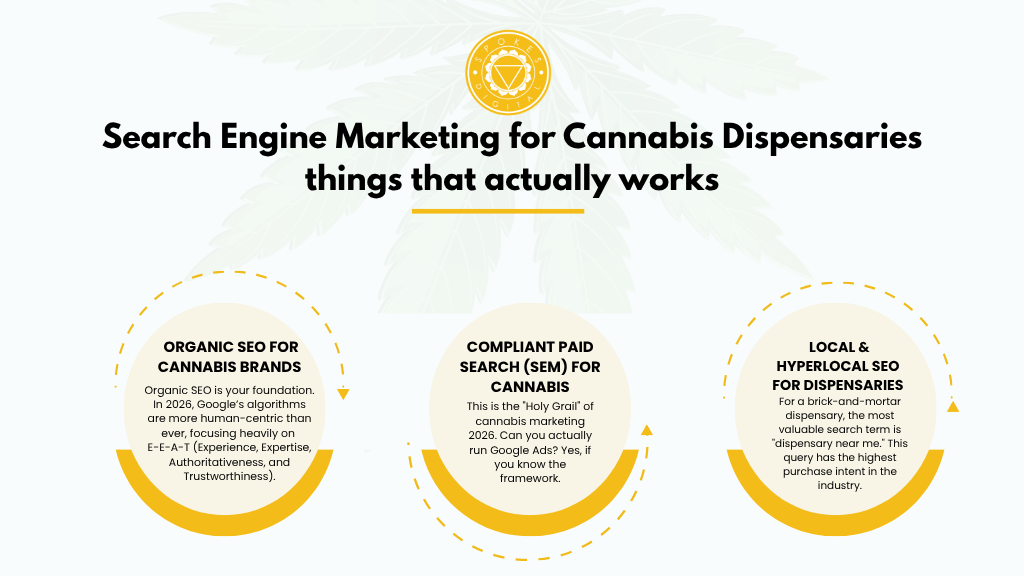
Pillar 1, Organic SEO for Cannabis Brands
Organic SEO is your foundation. In 2026, Google’s algorithms are more human-centric than ever, focusing heavily on E-E-A-T (Experience, Expertise, Authoritativeness, and Trustworthiness).
Content Strategy: Education Over Promotion
To comply with Google’s quality guidelines, the content needs to focus on wellness, usage, and education about strains. Instead of a page named “Buy Cheap Weed,” we create a page named “A Consumer’s Guide to Terpenes for Sleep” or “How to Choose the Right CBD Concentration for Anxiety.” This meets the user’s intent without tripping any of the illegal content filters.
AI-SEO: Scaling Growth
At Spokes Digital, we don’t guess what to write. We use AI-powered SEO tools to identify “keyword gaps”, terms your competitors are missing, and automate the creation of data-backed content briefs. This allows our clients to scale their organic footprint 10x faster than traditional agencies.
Technical Foundations
A slow site is a dead site. We optimize:
- Site Speed: Crucial for mobile users looking for a quick shop.
- Schema Markup: Helping Google understand your store hours, location, and product availability.
- Mobile-First Design: 80% of cannabis searches happen on a smartphone.
Pillar 2, Compliant Paid Search (SEM) for Cannabis
This is the “Holy Grail” of cannabis marketing 2026. Can you actually run Google Ads? Yes, if you know the framework.
How We Structure Compliant Ads
We use a “De-risked” ad structure. This involves:
- Compliant Ad Copy: Avoiding “trigger words” while maintaining high Click-Through Rates (CTR).
- Sanitized Landing Pages: Creating high-converting pages that provide value and information, serving as a “bridge” to your menu without violating platform policies.
- Negative Keyword Lists: We proactively block thousands of search terms that are known to trigger compliance audits.
Geo-Targeting to the Zip Code
Why waste money? We target high-intent buyers down to the specific neighborhoods surrounding your dispensary. By combining cannabis SEM with precise geofencing, we ensure your ads only show to people who are legally allowed to buy and physically able to visit.Result Proof Point: We have managed campaigns for brands like WholesomeCo, maintaining active ad spend for months with zero disapprovals in markets where others were banned in days.
Pillar 3, Local & Hyperlocal SEO for Dispensaries
For a brick-and-mortar dispensary, the most valuable search term is “dispensary near me.” This query has the highest purchase intent in the industry.
Google Business Profile (GBP) Optimization
Your GBP is your digital storefront. We manage:
- Keyword-Optimized Descriptions: Helping you rank in the top 3 of the Map Pack.
- Review Management: Strategies to increase your 5-star ratings (a huge ranking factor).
- Rank Bud-i: Our proprietary AI tool that monitors your local rankings in real-time, telling us exactly where you are winning and where a competitor is gaining ground.
The Direct Revenue Link
Local search visibility translates directly to dispensary foot traffic. When a customer sees your “Open Now” status and a 4.9-star rating on their phone while driving, the path to a same-day sale is almost guaranteed.
How AI Is Changing Cannabis SEM in 2026
Spokes Digital is the world’s largest AI cannabis performance marketing agency. We don’t just use AI to write blogs; we use it to predict the future.
- Ask Bud-i: OurAI chat assistant integrates with your site to personalize the landing page experience. If a user clicks an ad for “CBD for pets,” Bud-i greets them with pet-specific recommendations, skyrocketing conversion rates (CVR).
- Predictive Analytics: We use data models to forecast your return on ad spend (ROAS) before you even spend a dollar.
- Compliance Automation: Our AI-assisted checking system scans every line of ad copy against current Google and Meta policies before they go live, acting as an automated “insurance policy” for your accounts.
FAQ, Cannabis SEM Questions Answered
Can cannabis businesses run Google Ads in 2026?
Yes, but it’s not a simple set it and forget it type of thing. Google’s policies have changed a lot. For hemp-derived C B D products, ads are allowed in several regions as long as the products remain low in THC content and also have a certification from LegitScript. For T H C dominant dispensaries, it’s a more nuanced strategy. For example, it’s not allowed to advertise the sale of “marijuana,” but we use compliance-first bridge pages to focus on education, brand awareness, and the location of the business. By avoiding forbidden transactional language in ad copy and targeting high-intent informational keywords, we can keep dispensary ad campaigns live, campaigns that other agencies have deemed “impossible” to run.
What is the difference between SEO and SEM for dispensaries?
Think of SEO (Search Engine Optimization) as buying a home and SEM (Search Engine Marketing) as renting a high-traffic storefront. SEO is the long-term process of optimizing your website’s code, speed, and content so Google ranks you “organically” (for free) when someone searches for “best sativa strains” or “dispensary near me.” SEM is the broader umbrella that includes SEO but adds Paid Search (PPC). With SEM, you pay for top-tier visibility immediately. For a cannabis brand to dominate in 2026, you need both: SEO to build a foundation of trust and “free” traffic, and Paid SEM to capture immediate buyers who are ready to make a purchase right now.
How much should a dispensary spend on SEM per month?
There is no “one size fits all” number, but a competitive dispensary marketing budget usually starts between $3,000 and $7,500 per month for mid-sized local markets. In hyper-competitive hubs like Los Angeles, Chicago, or Denver, brands often spend $15,000 to $50,000+ to maintain dominance. The key is the “Test and Scale” model. At Spokes Digital, we recommend starting with a controlled budget to establish a compliant “baseline” with Google’s algorithms. Once the AI confirms your ad accounts are stable and the ROAS (Return on Ad Spend) is healthy, you can scale your budget aggressively to capture more market share.
Is cannabis advertising legal on Google?
Technically, Google’s Terms of Service (ToS) are private policies, not federal laws. While cannabis remains federally illegal in the US, Google allows advertising for certain topical CBD products and provides a “grey area” for informational dispensary content. The “legality” issue usually manifests as account suspensions rather than legal prosecution. To stay “legal” in the eyes of Google’s bots, you must avoid making medical claims (e.g., “this cures cancer”) and ensure your landing pages aren’t direct “Add to Cart” pages for restricted substances. Using an agency that understands these granular distinctions is the only way to advertise without losing your account.
What is the best digital marketing strategy for a dispensary in 2026?
The “Winning Trifecta” for 2026 is Hyperlocal SEO + AI-Driven Content + Compliant Programmatic Ads. First, you must own the “Map Pack” so local neighbors find you first. Second, you need a library of AI-optimized educational content that establishes your E-E-A-T (Experience, Expertise, Authoritativeness, and Trustworthiness). Finally, you layer on compliant paid ads to target “ready-to-buy” customers. By using AI tools like Ask Bud-i, you can personalize the shopping experience for every visitor, ensuring that the traffic you pay for actually converts into a sale.
How long does it take to see results from cannabis SEO?
SEO is a marathon, not a sprint. Generally, you will begin to see movement in keyword rankings within 45 to 60 days. However, significant “bottom line” results, meaning a massive influx of organic traffic and sales, typically take 4 to 6 months. This timeline is due to Google’s “indexing” phase, where it needs to see consistent, high-quality content and a clean technical site structure before it trusts you enough to outrank established competitors. The upside? Once you rank at the top, that traffic is “free,” providing a much higher long-term ROI than any paid advertising channel.
Get a Free SEM Audit, See Exactly Where You Are Losing to Competitors

Stop guessing why your competitors are outranking you. Our team will perform a deep-dive audit of your digital presence, checking your compliance risk, keyword gaps, and local SEO health.
- AI-Powered Insights: See exactly what your competitors are bidding on.
- Compliance Check: Identify “red flag” content on your site before it gets you banned.
- Proven Results: Backed by our 15-day money-back guarantee.